

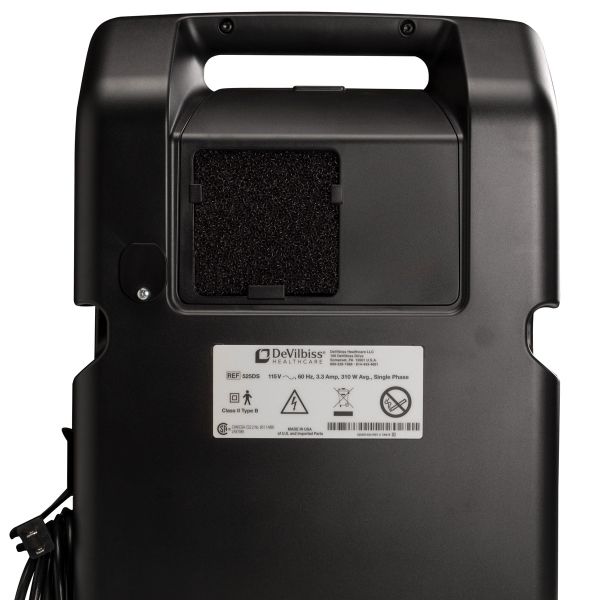
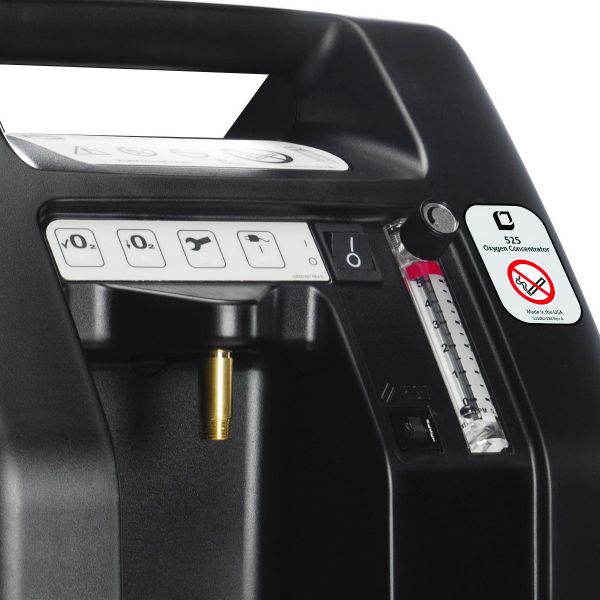
DeVilbiss 525DS 5 Liter
The workhorse home oxygen concentrator. Delivers up to 5 liters per minute of continuous oxygen with quiet operation and a built-in oxygen purity sensor.
Request this product- Quiet operation: runs at 48 dBA or less, quiet enough for a bedroom.
- Oxygen Sensing Device: continuously monitors oxygen purity so therapy stays reliable.
- Turn Down Technology: reduces internal system pressure by up to 35% at lower settings, extending the life of the machine.
- Easy to live with: smooth rolling wheels, top and side handles, simple control panel, and easy access to the oxygen connector and humidifier port.
- Safety alarms: power loss, low oxygen, and service alerts built in.
- Designed and made in the USA.
- Device type: Stationary home oxygen concentrator
- Flow settings: Continuous flow up to 5 LPM
- Oxygen concentration: 93% (plus or minus 3%) at 5 LPM
- Sound level: 48 dBA or less
- Dimensions: 24.5 x 13.5 x 12 in
- Weight: 36 lb
- Tubing length: Up to 57 ft of tubing and cannula
- Operating altitude: Up to 13,123 ft
- Warranty: 3 years
- HCPCS code: E1390
- Prescription required: Yes
Who it suits
A quick overview of this machine and who it works best for.

Good fit for:
- Patients prescribed continuous home oxygen for COPD, cardiovascular disease, or other lung disorders
- Patients who want a quiet unit that can run day and night
- Patients who move around the house, with up to 57 feet of tubing reach

Not a good fit for:
- Patients who need oxygen away from home (consider the portable Inogen One G4)
- Patients prescribed flows above 5 LPM (consider the 10 liter model)
Setup video
A quick overview of this machine and who it works best for.
How to get it?
Upload your prescription
Add it at checkout, or have your sleep clinic fax it to us directly.

We verify with your insurer
Our team checks your coverage and lets you know your out-of-pocket cost.

Your machine ships
Delivered in 3–5 business days, with setup support included.

Compatible masks
Quick answers
Do I need a prescription for home oxygen therapy?
Yes. Home oxygen therapy requires a valid prescription from a licensed physician specifying the flow rate and duration of use. Our team coordinates directly with your doctor to confirm the order, verify insurance, and schedule delivery.
What is home oxygen therapy?
Home oxygen therapy delivers supplemental oxygen to patients with low blood oxygen levels, usually caused by COPD, pulmonary fibrosis, severe asthma, heart failure, or other chronic lung conditions. Oxygen can be delivered via concentrator (which pulls oxygen from room air), compressed tanks, or liquid oxygen systems — your physician and respiratory therapist choose the setup based on your prescription and lifestyle.
What types of oxygen equipment do you provide?
We provide stationary oxygen concentrators for home use, portable oxygen concentrators (POCs) for travel and daily errands, and portable oxygen cylinders. Our respiratory therapists help match the right equipment to your prescribed flow rate and lifestyle.
Who qualifies for home oxygen therapy?
Home oxygen is a prescription therapy. For Medicare or insurance to cover it, your doctor must document through an arterial blood gas or pulse oximetry test that your oxygen saturation falls below a specific threshold at rest, during exercise, or overnight. AHCEQUIP works directly with your physician to gather the paperwork and arrange delivery.
How does oxygen delivery and home setup work?
After we receive your prescription and verify insurance, a licensed respiratory therapist delivers the equipment to your home, installs it, and walks you (and any caregivers) through safe operation, cleaning, and emergency procedures. We schedule routine supply deliveries and maintenance visits so you don't have to track them.
Oxygen concentrator vs. oxygen tank — which is right for me?
Oxygen concentrators pull oxygen from room air and run on electricity — so there's nothing to refill. They're the standard for most home patients. Compressed oxygen tanks are portable cylinders, useful as backup during power outages or for short outings. Many patients use a stationary concentrator at home plus a portable option or tanks for travel. Your AHCEQUIP respiratory therapist will recommend the right setup.
Can I travel with a portable oxygen concentrator?
Yes. All major airlines accept FAA-approved portable oxygen concentrators (POCs) onboard. Notify the airline at least 48 hours ahead, pack batteries for 1.5× your flight time, and bring your prescription and letter of medical necessity. POCs also run on standard vehicle outlets for road trips. We stock FAA-approved POCs — contact us before your trip so we can confirm your equipment is airline-ready.
Do you offer portable oxygen concentrators for travel?
Yes. We carry FAA-approved portable oxygen concentrators (POCs) for air travel. We can help you pick a model based on your prescribed flow rate and travel patterns, and provide the documentation airlines require.
How do I clean my nebulizer?
After every use, rinse the nebulizer cup and mouthpiece in warm water and air-dry on a clean towel. Once a day, wash with mild dish soap and rinse thoroughly. Once a week, disinfect by soaking in one part white vinegar to three parts water for 30 minutes, then rinse with sterile or distilled water and air-dry. Replace the nebulizer cup every 6 months or as directed by your doctor.
How do I maintain my nebulizer?
Rinse the nebulizer cup and mouthpiece with warm soapy water after every use. Once a week, fully disinfect using the manufacturer-recommended solution (typically a vinegar-water mix or sterilization tablets). Replace the cup, tubing, and filter per the manufacturer's schedule — usually every 3–6 months. Our respiratory team walks you through the full routine at delivery.
Products & Support You Can Rely On
Our team is here to assist with product choices and reordering essential supplies.
